Scams Information and Advice
This booklet was made by Lewisham Speaking Up on behalf of the Lewisham Safeguarding Adults Board.
Read and download the Scams Easy Read Booklet
What is Fraud
Fraud is when a person lies to you, or ‘scams’ you, to gain an advantage, such as taking your money or learning private information about you.
This could be by email, text, phone or in person, either on the street or on your doorstep.
Criminals are turning to more sophisticated ways to take your money, whether through online offers, emails or telephone calls.
Scams affect the lives of millions of people across the UK. People who are scammed often experience shame and social isolation as a result.
With a little knowledge you can protect yourself from fraudsters.
Watch out for Scams like these
- Banking Fraud
- Cash Machine Fraud
- Cheque Scam
- Holiday Fraud
- Identity Theft
Watch this video from the Metropolitan Police Service on online shopping fraud
Watch this video from the Metropolitan Police Service on Impersonation Fraud
Investing in stocks and shares or any other commodity can be a successful way of making money. However, it can also lead to people losing their entire life savings. Fraudsters will persuade you to invest in all kinds of products. They will offer you high rates of return, particularly over longer periods of time, which often do not exist.
Common products that will be offered include binary options, virtual currency, carbon credits, wine, rare metals, gemstones, land and alternative energy. Often, initial investments will yield small returns as an incentive to invest further funds. However, larger investments or cashing out will be met with excuses or a penalty charge. Eventually contact with the fraudster will be impossible and all funds and bogus returns lost.
Fraudsters are organised and they may have details of previous investments you have made or shares you have purchased. Knowing this information does not mean they are genuine.
Criminals may direct you to well-presented websites or send you glossy marketing material. These resources do not prove they are a genuine company. Many fraudulent companies have a polished customer image to cover their illegal activities.
It is relatively easy to register a company with Companies House. This does not confirm or endorse that they can provide genuine investments. Indeed, emerging investment markets may be unregulated, making these open to abuse.
- Invoice and Mandate Fraud
- Payment in Advance Fraud
- Purchase Scam
Companies may be registered at prestigious addresses, for example Canary Wharf or Mayfair. This does not mean they operate from there. It is an accepted business practice to rent such a virtual office to enhance a business’s status. However, fraudsters are also aware of this and exploit it. The fraudster may put pressure on you by offering a ‘once in a lifetime opportunity’ or claim the deal has to be done quickly to maximise profit.
In addition - be wary of companies that offer to ‘recover’ any funds you have lost to any sort of investment scam. They may be linked to the company who initially defrauded you in the first place and may be targeting you again. This is known as ‘Recovery Fraud’.
How to protect yourself
- There are no get rich quick schemes. If it sounds too good to be true, it probably is.
Genuine investment companies will not cold call you. Be extremely wary of anyone who does.
- Research both what you have been offered, and the investment company. Speak to Trading Standards if you have concerns.
Before investing, check the Financial Conduct Authority register to see if the firm or individual you are dealing with is authorised (https://register.fca.org.uk/)
- Check the FCA Warning List of firms to avoid.
REMEMBER - Don’t be pressured into making a quick decision.
CAUTION - Seek independent financial advice before committing to any investment.
THINK - Why would a legitimate investment company call me out of the blue?
Sometimes, criminals advertise properties to rent when these properties don’t belong to them, or even don’t exist! Victims are then tricked into paying an upfront fee to rent the property.
In reality, the property does not exist, has already been rented out, or has been rented to multiple victims at the same time. The victim loses the upfront fee they have paid and is not able to rent the property they thought they had secured with the payment. Rental fraudsters often target students looking for university accommodation.
How to Protect Yourself
- Do not send money to anyone advertising rental properties online until you are certain the advertiser is genuine.
- If you need to secure accommodation in the UK from overseas, seek the help of the employer or university you are coming to, or get a friend, contact or relative to check the property exists and is available.
- Do not pay any money until you or a reliable contact has visited the property with an agent or the landlord.
- Ask for copies of tenancy agreements and any safety certificates such as Gas Electricity or HMO Licence.
- Do not be pressurised into transferring large sums of money. Transfer funds to a bank account having obtained the details by contacting the landlord or agent directly after the above steps have been followed. Be sceptical if you’re asked to transfer any money via a money transfer service like Western Union.
- Romance and Dating Fraud
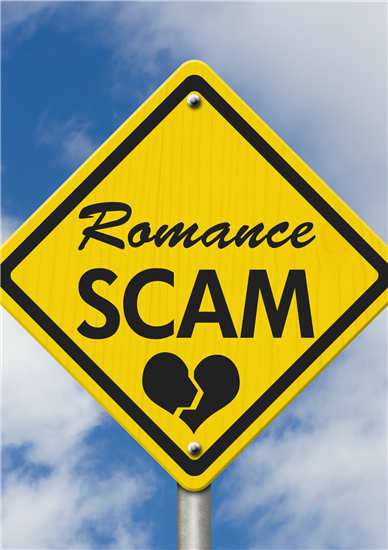
Dating online is now one of the most popular ways for new couples to meet, with millions of people finding new relationships, romance and love this way. Unfortunately, amongst the genuine profiles are fake profiles set up by fraudsters.
Criminals create fake online personas to gain someone’s trust and affection through the guise of a romantic relationship, with the ultimate goal of exploiting them for financial gain.
They will quickly ask to move communication off a dating website. This is so they can continue their contact with you, even if their profile is later identified by the site as fraudulent and subsequently deleted.
Fraudsters are often very flattering, appearing really interested in you within a short space of time. However, they will use a range of excuses as to why they can’t meet in person, such as they are stuck overseas, have a family emergency or have an issue with their business. Romance fraudsters use language to manipulate, persuade and exploit. They work hard to make sure that when they ask for money, and require urgency or secrecy from the victim, it doesn’t set off alarm bells.
They then start asking for money to help with their problems, assuring you they will pay it back as soon as they can. The fraudster may claim to be desperate to meet you as soon as this obstacle is overcome. This is all a scam and their true intention is to take as much money from you as they can.
In addition to the financial loss and subsequent hardship, victims of romance fraud also suffer the loss of a partner and support system, and a future that they believed in. They also have to come to terms with having been manipulated and deceived in such a callous, calculated way. For almost a third of those targeted, the fraud spans more than a year – for some, many years. Due to the isolation tactics used by fraudsters, the victim’s relationships with family and friends are often damaged and they are left alone and vulnerable.
How to protect yourself from romance fraud
If you’re in a relationship with someone you’ve only met online, any requests for money should ring an alarm bell. However sad or urgent their story is, never send money (that includes vouchers, cryptocurrency or money for investments). Report anyone who asks for money to the dating service immediately.
- Get to know the person, not the profile
Treat people as you would if meeting in person, by asking questions and taking your time. Check the person online using Google image search or TinEye to see if their profile pictures can be found elsewhere online. Be cautious about how much information you share, and keep your social media accounts private and secure.
- Talk to friends and family
Sometimes a second opinion can really help if you are uncertain about something, such as being asked for money by someone you’re in an online relationship with. Be wary if you meet someone online who asks you not to tell anyone about them.
Watch Sarah's Story
What to do if you have already been a victim of romance fraud
If you have made a payment: Inform your bank as soon as possible, they can help you prevent any further losses. Monitor your bank statements regularly for any unusual activity.
Identity theft: If you have shared personal or financial information, and suspect your identity may have been stolen, you can check your credit file quickly and easily online. You should do this every few months anyway, using a reputable service provider and follow up on any unexpected or suspicious results. You can also sign up for Cifas services which can help to protect you against fraud.
You could be targeted again: Fraudsters sometimes re-establish contact with previous victims claiming that they can help them recover lost money. Hang up on any callers that claim they can get your money back for you.
How to report romance fraud
If you think you have been a victim of romance fraud, remember that you are not to blame, do not feel ashamed or embarrassed - you are not alone, help is out there. Please report it to Report Fraud on 0300 123 2040 or via our reporting hub.
Find out more about Romance Fraud from Report Fraud
Doorstep Crime and Scams

Remember:
Your bank, the police, or the tax office will never ask you to attend your bank, withdraw, transfer or pay money over the phone or send couriers to collect your card or cash. Nor would they ask you to buy goods or vouchers.
This is a scam.
Hang up (Never give details or money following a cold call)
Take 5 (Seek a second opinion, tell someone what has happened)
Verify (if concerned, contact the company via a pre-confirmed method)
Friends Against Scams is a National Trading Standards (NTS) Scams Team initiative, which aims to protect and prevent people from becoming victims of scams by empowering communities to "Take a Stand Against Scams".
Friends Against Scams has been created to tackle the lack of scams awareness by providing information about scams and those who fall victim to them. This information enables communities and organisations to understand scams, talk about scams and cascade messages throughout communities about scams prevention and protection.
Friends Against Scams encourages communities and organisations to take the knowledge learnt and turn it into action.
Friends Against Scams Easy Read Resources Webpage
Anybody can join Friends Against Scams and make a difference in their own way.
Become a friend
If you would like to be a Friend Against Scams you can attend a short awareness session in person or complete the online training.
After this session you will be asked to start taking action to "Take a Stand Against Scams".
Beware if you receive a text message purporting to be from a trusted organisation such as your bank – can you be sure it’s genuine?
It is a good idea to follow the advice from Take Five
STOP
Taking a moment to stop and think before parting with your money or information could keep you safe.
CHALLENGE
Could it be fake? It’s ok to reject, refuse or ignore any requests. Only criminals will try to rush or panic you.
PROTECT
Contact your bank immediately if you think you’ve fallen for a scam and report it to Report Fraud
Ten Golden Rules to Prevent Fraud
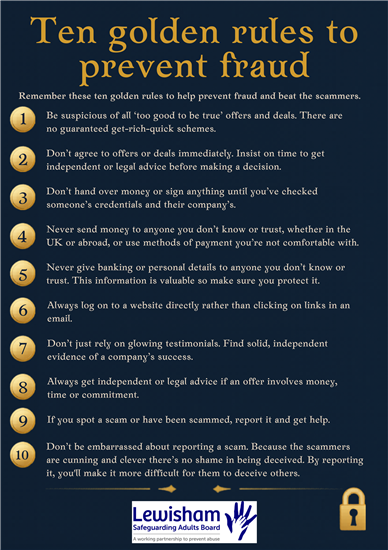
Download the Ten Golden Rules to Prevent Fraud Poster
Get help or report a scam
If you think you’ve uncovered a scam, been targeted by a scam or fallen victim to fraudsters, please report it to Report Fraud on 0300 123 2040 or via our reporting hub.
Call the Police on 101 if you know the suspect or they’re still in the area.
Reporting crime, including fraud, is important. If you don’t tell the authorities, how do they know it’s happened and how can they do anything about it?
Remember that if you’re a victim of a scam or an attempted scam, however minor, there may be hundreds or thousands of others in a similar position. Your information may form part of one big jigsaw and be vital to completing the picture.
Supporting Older Victims of Technology- Facilitated Domestic Abuse
The Centre For Age Gender and Social Justice [Dewis Choice] has just launched a new Supporting Older Victims of Technology- Facilitated Domestic Abuse. “Limited exposure to technology, lower confidence in navigating digital tools, and unfamiliarity with online risks can expose older adults to risks such as scams, fraud, and technology-facilitated abuse (Independent Age, 2024)”.
Dewis Choice Practitioner Guide 2025

Scams Prevention Advice and Support From Lewisham Council
Lewisham Council's Safer Communities Service can provide support if you have been the victim of a scam. They can also give advice and talks on how to prevent scams, and discuss any concerns you have about scams.
Find out more on how the Safer Communities Service can help you.
Age UK Avoiding Scams Guide
Crimestoppers Romance Fraud e-Booklet
Change People.org Keeping-Safe-Online-Easy-Read-Guide
Scam Marshals - play a role in helping National Trading Standards (NTS) Scams Team to stop scam mail (friendsagainstscams.org.uk)